15yrs | Our founding story
Where better to start our anniversary blog series, than by hearing from the people who founded the Centre back in 2011. Professors Mike Depledge CBE, Emma Bland, and Lora Fleming Hon CBE give us a potted history of how they got the Centre off the ground, including that infamous lunch at an Italian restaurant in Truro.
Mike: The author, Arthur C. Clark pointed out that new ideas pass through three periods; “It can’t be done”; “It probably can be done, but it’s not worth it”; and “I knew it was a good idea all along!”
The first conversations I had about setting up a research centre in Cornwall were with Sir John Tooke, founder of the Peninsula Medical School, some twenty years ago in 2006. We discussed the idea of a dedicated centre that could investigate the interconnections between environment and human health, considering both health threats and opportunities as our world changes.
Over the next three years, discussions simmered and bubbled with colleagues at the medical school, EU officials, and many stakeholders across Cornwall until the idea of the European Centre for Environment and Human Health finally crystallised. But who would fund such an endeavour?
Emma: At that time, Cornwall and the Isles of Scilly were defined by the EU as a region needing economic support and so received a significant ‘Convergence’ grant to boost performance. But there was a catch: Convergence was a commissioning programme – we had to persuade its budget holders to commission a new research centre focused on environment and health.
This was further complicated by the EU’s desire to deliver economic benefit, at a time when the links between economic gain and academic research were less appreciated by decision-makers. I quickly learned a valuable lesson in perspective: rather than discussing the inherent value of our science, we had to show the economic benefits it would help to unlock.
To achieve this we pioneered several innovative ways to work with local businesses, and became fluent in calculating and forecasting the monetary impact of our proposed work.
Mike: Whilst Emma worked with Peninsula Medical School professors, Tony Pinching and Angela Shore, to assemble the vital economic case, I got to work on the scientific concept. I had always envisaged an interdisciplinary centre composed of about 60 natural, social, and medical scientists, working alongside economists, conservationists, graphic artists, and others, to break down the traditional silos that seemed to keep disciplines and research groups apart. The team would address a diverse array of topics, from local issues through to global challenges, and convey findings to national and international policymakers.
With the unstinting support of my PA, Joanne Jacob, I embarked upon a campaign of lectures to raise the profile of this still imaginary centre, speaking to government departments, funding bodies, universities, research institutes and NGOs across the UK, Europe, and other parts of the world. But despite significantly raising our profile, 2009 was also littered with some disappointing setbacks, chief among them the news that the key body involved in the process, the Endorsement Advisory Group, was unlikely to support us – dooming our efforts to certain failure.
In a final endeavour to make our case, we scheduled a last-minute meeting with the advisory group at an Italian restaurant in Truro, giving an impassioned presentation and suffering a gruelling interrogation. We left with the fate of our efforts hanging in the balance.
Emma: Against all the odds, in September 2009, we received confirmation that our idea had been commissioned! And yes, the last-ditch lunch might have clinched the deal, but this success was only made possible by generous support from countless colleagues across our own institution, local partner universities, and organisations.
Crucially, we secured both capital and revenue funding that allowed us to create a bespoke research facility at the Royal Cornwall Hospital site, complete with office and shared atrium space, and to build a new team of researchers and business engagement professionals.
With over 60 positions to fill, we embarked upon a daunting recruitment process. Starting, of course, with the appointment of our new director.
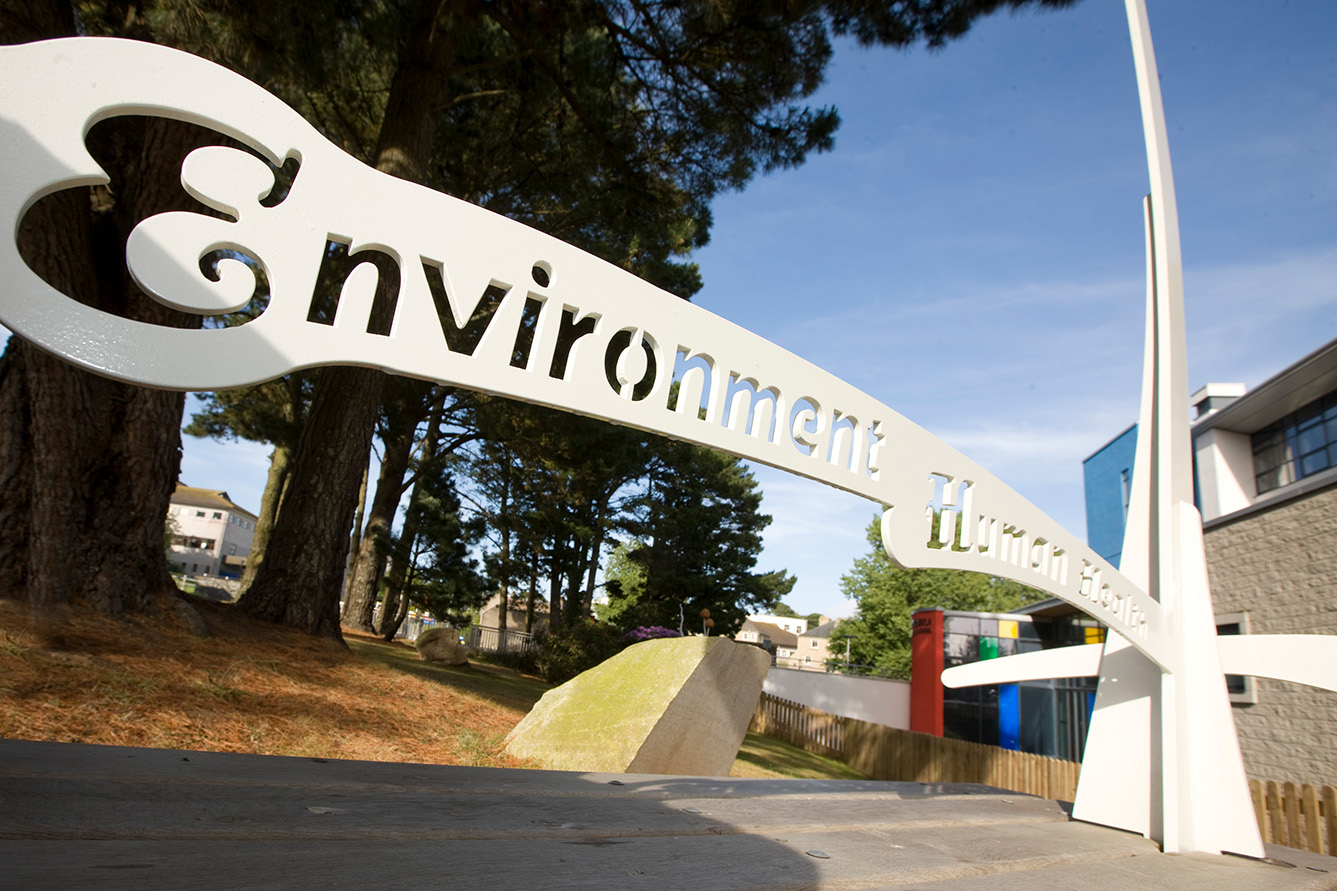
An artist-designed bench outside the Centre’s first home in Truro.
Lora: Where the heck is Cornwall, I first thought? In the summer of 2010 – after more than 20 years in Miami, Florida – I was intrigued at the chance to help establish a new EU-funded research centre in Cornwall. After a lengthy phone interview with at least 12 strangers, I was lucky enough to be offered the position of centre director.
Thanks to the work of Emma, Mike, and many others, I arrived at a lovely new home at the freshly extended “Knowledge Spa” – my first taxi driver to “the Spa” asked me if we had massages and saunas in the building! Quite the opposite: the European Centre for Environment and Human Health was empty. And so we hit the ground running, spending the next year on interview panels with Mike, Emma, Angela Shore, Petrina Bradbrook, and Ben Wheeler.
Emma: Our ethos, and indeed our funding, aimed to bring research expertise to Cornwall and keep it here. And so we stipulated that all new recruits must live in Cornwall. Looking back, with the experience of Covid and remote working now routine, this may seem draconian but it worked, helping to create a vibrant and supportive research environment.
To encourage transdisciplinary working, we also decided not to seat people in teams, but to mix disciplines together in shared offices. In our collaborative atrium space, we created opportunities to engage informally – an ever present jigsaw puzzle proving a highly successful tool, as well as weekly cake (and fruit) sharing events and more formal seminars, meetings, and special occasions.
All this helped to reduce hierarchy and create a welcoming, supportive culture which, despite many changes in staff, location, and parent institution, endures to this day.
Lora: We wanted a major emphasis to be on interdisciplinarity in environment and human health writ large – not only traditional academic and administrative disciplines, but diverse skill sets including the arts. We hoped to be able to provide opportunities for local people to gain access to careers and higher degrees not previously offered in Cornwall, as well as appealing to those who were interested in moving to live and work in the county. And thanks to Emma and more EU funding, we were lucky to obtain our first cohort of PhD students, kicking off our applied research with businesses and NGOs.
At that time, environment and human health wasn’t really recognized as an important area, especially thinking about the benefits, as well as the risks, of human interactions with nature. And even though we had amazing EU funding, it was time limited; with the expectation that we would “float our own boat” within a few years.
Meanwhile, I had rapidly acquired some essential Cornish skills and kit: all weather gear, hiking boots, train schedules, and cream teas. And we began the ongoing establishment of “Cake and Fruit Fridays”, obligatory pot luck Thanksgiving celebrations, volunteer days, endless meetings and retreats, and many other celebrations that would inevitably make me cry (with gratitude)!
Ultimately thanks to the efforts of everyone at the Centre, and with support from the medical school and wider community, we began to win funding from almost all UK and EU funders to deliver cutting edge interdisciplinary environment and human health research – both within Cornwall and internationally. And we started to have an impact on local and international policy which continues to this day, including becoming a WHO Collaborating Centre in Natural Environments and Health (which is a story for another day)!
As I reflect on my own Centre journey in Cornwall, I remember the amazing committed people who care both about the environment and health, but also each other. I cherish laughing a lot, and always learning new and exciting ways of thinking and being. It has been a privilege.
Emma: The European Centre for Environment and Human Health was built from scratch – we started with a blank piece of paper, as it were. It’s testament to all of the people who have come, gone, and stayed, that the Centre is still thriving, and continuing to change the ways we understand the environment and health. Long may it last!
Mike: Twenty years on from that blank piece of paper and 15 years since our official launch, everyone, of course has confirmed that Arthur C. Clark was right: they “knew it was a good idea all along!”