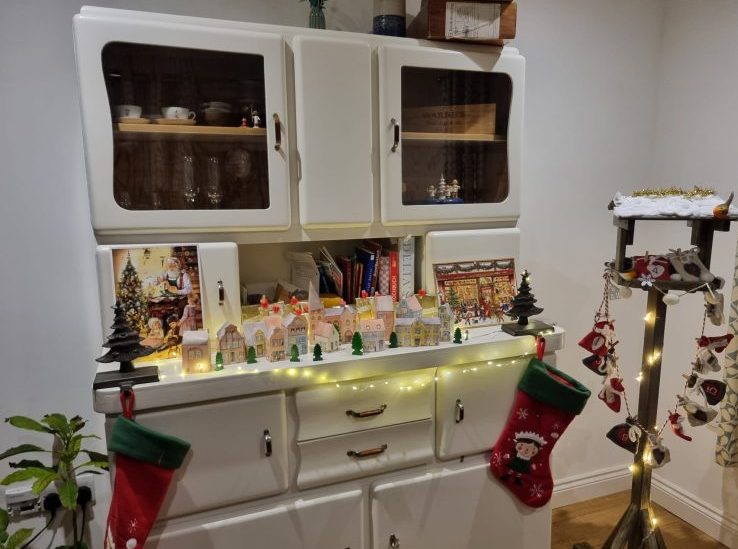
My academic advent calendar 2025: A paper a day…
Written by Gesche Huebner
It has arrived again, the season of Advent. As every year, it feels busy and hectic, at work and at home. But for 2025, I’ve decided to revive an idea I had a few years back: an academic Advent calendar, with a paper to read each day.
Partly, to create a space, a moment of focus every day in this busy period.
Partly, because I had promised myself when I took over the directorship of the European Centre for Environment and Human Health in 2024 that I would read EVERY SINGLE PAPER written by my colleagues. Well, I spectacularly failed at that – there were always too many things to do, and my wonderful colleagues are prolific at paper-writing! This is my moment to catch up – and here it is my, my academic paper advent calendar 2025.
With apologies to everyone whose paper is not included – there are just too many; it is no judgement on quality or importance but largely driven by the list of published papers I had at hand!
1st of December:
Garrett, J.K., Elliott, L.R., Lovell, R. et al. (2025). A novel approach for mapping exposure to land cover at the small statistical geography level. Int J Health Geogr 24, 37. https://doi.org/10.1186/s12942-025-00425-7
Linking spatial environmental exposures to health outcomes is crucially important – but not trivial. Here, the authors combined LSOA and post code level to draw more detailed conclusions around exposure to non-built up areas.
2nd of December:
Walton, A., Taylor, T., Longo, A., et al. (2026). Understanding the influence of gender, masculinity, and femininity on attitudes and behaviours around meat consumption: Comparison of measures to better inform policy action. Food Policy, 138, 103002. https://doi.org/10.1016/j.foodpol.2025.103002
Food plays an important role around Christmas – and masculinity and femininity traits might contribute to deciding what ends up on the table!
3rd of December:
Sünderhauf, D., Winter, M., Ramshaw, J., et al. (2025). Seaweed exposure modulates Escherichia coli plasmid conjugation rate. Microbiology, 171(10), 001622. https://doi.org/10.1099/mic.0.001622
I have to start off by searching what “plasmid conjugation rate” means! The paper shows that three seaweed species induce distinct conjugative behaviours in E. coli – i.e the ability of E. coli to pass on genetic traits depend on what seaweed it landed on.
4th of December:
Ferguson, M., Teyhan, A., Lovell, R., et al. (2025). The association between park visits, outdoor play and child social-emotional competency in a multi-ethnic, urban cohort. Wellbeing, Space and Society, 9, 100293. https://doi.org/10.1016/j.wss.2025.100293
Using data from more than 2500 children, the authors showed that one third of all children to not play outdoors after school, and one fifth do not over the weekend! That is pretty shocking given how important play is for children!
5th of December:
Harvey, T., White, M. P., Pahl, S., et al. (2025). Happy days are nature days: visiting nature has positive spill-over effects for the entire day among people with and without common mental health disorders. The Journal of Positive Psychology, 1–14. https://doi.org/10.1080/17439760.2025.2549296
How about planning a nature trip for the weekend? This paper suggests that that this will create positive spillover, creating greater levels of wellbeing for the whole day. And take the kids!
6th of December: Saturday so no paper – but it is St. Nicholas day in case that’s of interest!
7th of December: Sunday
8th of December:
Martin, L., White, M.P., Pahl, S. et al. (2025). Nature contact and health risk Behaviours: Results from an 18 country study. Health & Place, 94. https://doi.org/10.1016/j.healthplace.2025.103479
Staying on the theme of positive effects of nature, here the authors showed that visiting natural spaces at least once a week was linked to lower levels of smoking. This finding was relatively consistent across 18 countries.
9th of December:
Giltenane, M., O’Mahony, A., Bianchim, M.S., et al. (2025). Assessing the reporting quality of published qualitative evidence syntheses in the cochrane library. Cochrane Evidence Synthesis and Methods. https://doi.org/10.1002/cesm.70023
Qualitative evidence synthesis and mixed-methods reviews are becoming increasingly common and influential – but how well are they done? Unfortunately, not as well as you’d hope for with only 26% meeting satisfactory reporting standards.
10th of December:
Moon, K., van Bavel, B., Berrang Ford, L., et al. (2025). A research agenda advancing climate change and antimicrobial resistance as interconnected issues. Nature Climate Change, 1–4. https://doi.org/10.1038/s41558-025-02507-7
It has been recognized that climate change and antimicrobial resistance (AMR) are as urgent and converging global threats – but there is a lot about the complexity of their relationship, that we don’t know. Here, the authors share a solution-focused research agenda to help inform global responses to AMR and climate change.
11th of December:
Hayes, A., Zhang, L., Feil, E., et al. (2025). Antimicrobial effects, and selection for AMR by non-antibiotic drugs in a wastewater bacterial community. Environment International, 199, 109490. https://doi.org/10.1016/j.envint.2025.109490
This paper looks at non-antibiotic drugs, and shows that non-antibiotic drugs affect community growth, function, and potentially selection for specific metal resistance genes.
12th of December:
Zhang, H., Evangelopoulos, D., Wood, D. et al. (2025). Estimating exposure to pollutants generated from indoor and outdoor sources within vulnerable populations using personal air quality monitors: A London case study. Environment International, 198, 109431. https://doi.org/10.1016/j.envint.2025.109431
Personal exposure to air pollution can originate from indoor or outdoor sources – understanding their relative contribution is important to inform targeted interventions.
13th of December:
Asker, C., McGuire, L., Pollard, T., et al. (2025). Manoeuvring rural mobility policy for active and sustainable travel. Social Science & Medicine, 377, 118074. https://doi.org/10.1016/j.socscimed.2025.118074
As someone who uses the bike as much as possible, this paper struck a chord: Active transport is crucial for public health and net-zero strategies – but it is very difficult in rural areas! The authors conducted situational analysis drawing on local and national documents and stakeholder interviews to explore the policy ecology of local authority ambitions and practices for creating and implementing active transport policy for rural communities.
14th of December: Saturday
15th of December: Sunday
16th of December
Leonard, A. F. C., Higgins, S. L., Hui, M., et al.(2025). Investigating landscape-scale variables impacting human exposure to antibiotic resistant bacteria using a targeted metagenome approach. Environmental Pollution, 372, 126015. https://doi.org/10.1016/j.envpol.2025.126015
Research has shown that exposure to coastal waters containing antibiotic resistant bacteria (ARB) is associated with higher likelihood of gut colonisation by ARB. In Hong Kong, 1.16 million coastal bathing events involved ingestion of E. coli-borne ARGs.
17th of December
Simpson, C.H., Brousse, O., Taylor, T. et al. (2025). The mortality and associated economic burden of London’s summer urban heat island effect: a modelling study. The Lancet Planetary Health, 9 (30). https://doi.org/10.1016/S2542-5196(25)00025-7
It might be winter now but the next heatwave is closer than it might seem – and maybe we should not look forward to it… This paper was led by my wonderful former colleagues at UCL but in collaboration with multiple ECEHH staff members. Using modelling, the study estimated the mortality burden in terms of attributable mortality and years of life lost, and social costs attributed to the urban heat island effect in summer 2018 in Greater London. In summary: many deaths and very high social costs, highlighting how serious heat is as a health risk.
18th of December:
Jones, M.L., Leonard, A.F.C., Bethel, A. et al. (2025). Recreational exposure to polluted open water and infection: A systematic review and meta-analysis protocol, Environment International, 200. https://doi.org/10.1016/j.envint.2025.109371
Open water recreation is popular but there are concerns about contracting infections as a result of wastewater and runoff pollution in open water – a really important topic where we need to be clear on the evidence. So great to see a protocol for a systematic review and meta-analysis on this topic!
19th of December:
Steininger, M.O., White, M.P., Lengersdorff, L. et al. (2025). Nature exposure induces analgesic effects by acting on nociception-related neural processing. Nat Commun 16, 2037. https://doi.org/10.1038/s41467-025-56870-2
If all those papers have given you a headache, try looking at some images of nature! The authors showed that participants who received electrical shocks reported less pain when viewing virtual nature as opposed to urban images, and the brain areas responsible for pain showed less activation.
20th of December: Saturday
21st of December: Sunday
22nd of December:
Conzatti, A., Fosas, D., Kershaw, T., et al. (2025). The influence of occupant behaviour on indoor air quality and COVID-19 risk in refugee shelters and temporary houses The influence of occupant behaviour on indoor air quality and COVID-19 risk in refugee shelters and temporary houses. Building Services Engineering Research & Technology, 46(6). https://doi.org/10.1177/01436244251340358
Poor indoor air quality is a health risk for occupants. This study presents a novel, low-cost method for monitoring indoor air quality and ventilation in temporary shelters and refugee housing.
23rd of December:
Groeneveld, W., Krainz, M., White, M.P. et al. (2025). The psychological benefits of open-water (wild) swimming: Exploring a self-determination approach using a 19-country sample. Journal of Environmental Psychology, 102. https://doi.org/10.1016/j.jenvp.2025.102558
If you are not sure if you should go for a Christmas dip in cold water this year, take a look at this paper. Using data from 19 countries, it showed outdoor swimming was linked to positive well-being, and that open-water swimming was linked to higher well-being than open-air pool swimming. Maybe just check there are no local sewage discharge events…
24th of December:
The University of Exeter has given all staff an additional day of leave so no more papers! Merry Christmas!